UPI has been one of India's most widely used digital payment methods, allowing individuals and businesses to make and receive payments quickly. From October 15, 2026, however, a new Merchant Discount Rate (MDR) framework will apply to certain high-value UPI merchant transactions.
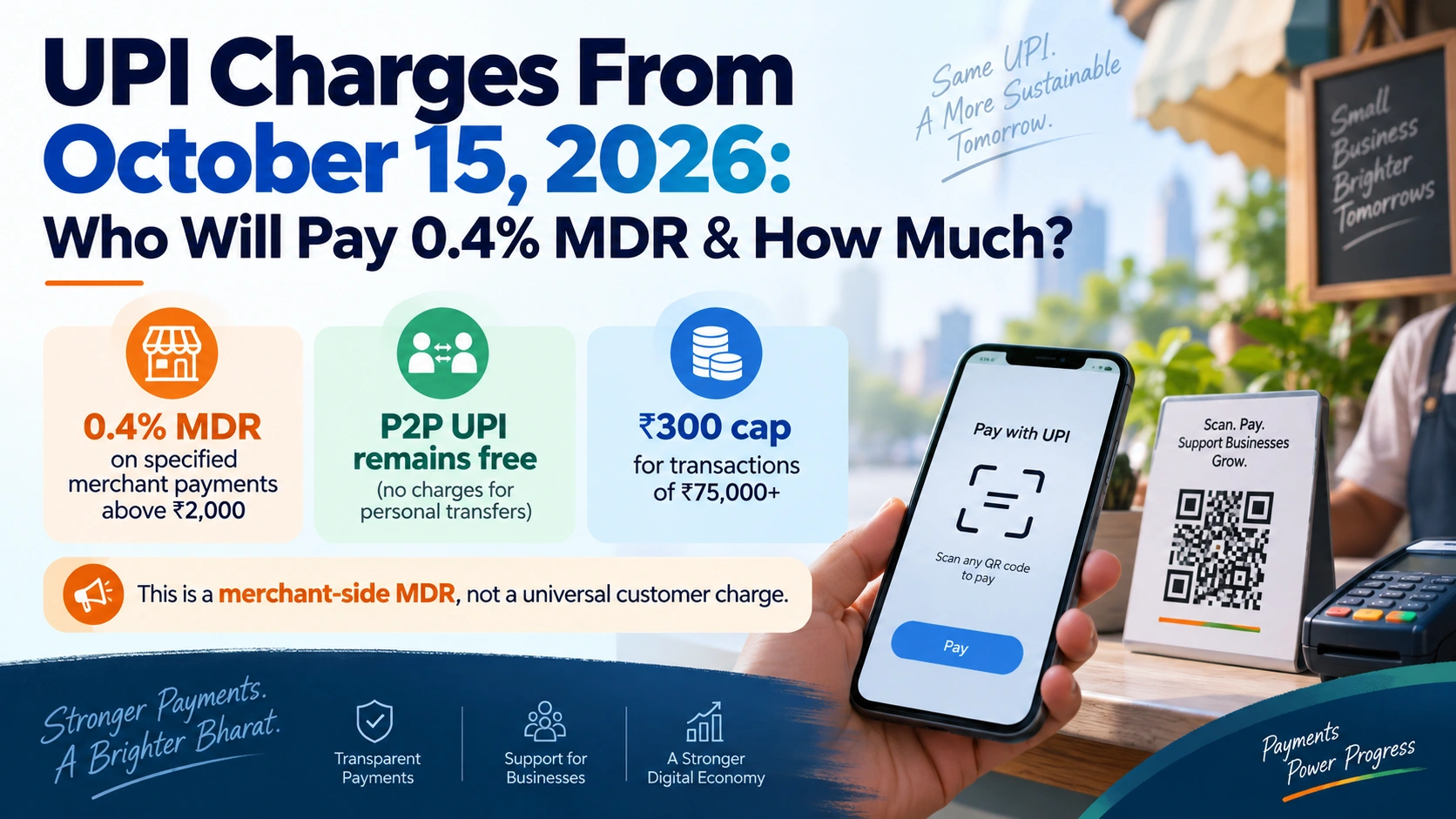
The most important point for consumers is that this does not mean UPI will become chargeable for everyone. Person-to-person (P2P) UPI transactions will remain free, and merchant payments of up to ₹2,000 will also remain free of MDR. The new 0.4% MDR will apply to specified person-to-merchant (P2M) transactions above ₹2,000.
This article explains the new UPI MDR rules, who will pay, how much the charge can be, which transactions remain free, and what businesses should know before the new framework takes effect.
What Is Changing in UPI From October 15, 2026?
Under the new framework, a 0.4% Merchant Discount Rate (MDR) will apply to specified person-to-merchant UPI transactions above ₹2,000. For transactions of ₹75,000 or more, the MDR will be capped at ₹300 per transaction. The new framework is scheduled to take effect from October 15, 2026.
Importantly, MDR is a payment-processing charge within the merchant payment ecosystem. It is not a tax collected by the Government or NPCI. The amount is distributed among participants in the payment ecosystem, including banks and payment service providers.
Will Customers Have to Pay UPI Charges?
No blanket UPI charge is being introduced for customers. The Government has clarified that individuals will continue to be able to use UPI for person-to-person transactions without a transaction, platform or other UPI charge.
For example, if you send ₹50,000 to a friend or family member through UPI, the transaction remains free.
Similarly, merchant payments up to ₹2,000 will remain free of MDR. Banks have also been advised to ensure that merchants do not pass the MDR on to customers as a separate UPI charge.
What Is MDR in UPI?
MDR stands for Merchant Discount Rate. It is a fee associated with processing a merchant payment. Under the new UPI framework, the applicable MDR is paid within the payment ecosystem rather than being a tax collected by the Government.
For specified P2M transactions above ₹2,000, the standard MDR will be 0.4%, subject to applicable sector-specific rules and transaction caps.
Simple Example
Suppose a customer pays a merchant:
- Payment amount: ₹10,000
- Applicable MDR: 0.4%
- MDR amount: ₹40
The ₹40 represents the MDR calculated on the transaction amount, subject to the applicable framework.
For a ₹50,000 transaction:
- Payment amount: ₹50,000
- MDR at 0.4%: ₹200
For transactions of ₹75,000 or more, the standard MDR is capped at ₹300 per transaction.
Which UPI Transactions Will Remain Free?
Several categories remain outside the new MDR framework.
1. Person-to-Person UPI Payments
UPI payments between individuals will remain free regardless of the amount transferred.
For example:
- ₹5,000 sent to a friend — Free
- ₹25,000 sent to a family member — Free
- ₹1 lakh sent to another individual — Free
The Government has specifically clarified that P2P transactions will remain completely free.
2. Merchant Payments Up to ₹2,000
P2M transactions up to ₹2,000 will remain free of MDR.
For example, a customer paying ₹1,500 to a shop through UPI will not attract the new 0.4% MDR.
3. Eligible Small Merchants
Small merchants receiving up to ₹1 lakh per month through UPI QR codes under the applicable P2PM category will continue to receive payments without MDR. This provision is intended to protect small businesses such as street vendors, neighbourhood shops and other eligible small merchants.
According to the Ministry of Finance, approximately 96% of P2M UPI transactions will remain unaffected by the new framework.
What Is the UPI Charge Above ₹2,000?
For specified P2M transactions above ₹2,000, the standard MDR is:
0.4% of the transaction value
However, there is a maximum cap:
₹300 per transaction for transactions of ₹75,000 and above.
| UPI Merchant Payment | Standard MDR |
|---|---|
| ₹1,500 | No MDR |
| ₹2,000 | No MDR |
| ₹5,000 | 0.4% = ₹20 |
| ₹10,000 | 0.4% = ₹40 |
| ₹25,000 | 0.4% = ₹100 |
| ₹50,000 | 0.4% = ₹200 |
| ₹75,000 | ₹300 cap |
| ₹1,00,000 | ₹300 cap |
These examples illustrate the standard 0.4% framework; sector-specific rules can differ.
Are There Different UPI MDR Rates for Certain Sectors?
Yes. The framework provides separate provisions for certain essential and thin-margin sectors.
For transactions above ₹2,000 involving sectors such as:
- Railways
- Telecommunications
- Insurance
- Fuel
- Agricultural inputs
a flat MDR of ₹5 per transaction will apply under the specified framework.
There is also a separate rate for capital-market transactions.
What Is the UPI MDR for Mutual Funds and Stockbrokers?
Payments relating to mutual funds, securities, stockbrokers and dealers will attract an MDR of 0.02%, capped at ₹300 per transaction, under the new framework.
This is particularly relevant for investors and financial businesses because the rate is different from the standard 0.4% applicable to specified merchant transactions.
Does This Mean UPI Is No Longer Free?
Not for ordinary UPI users in the broad sense. The new framework does not introduce a universal charge for using UPI.
The following will continue to remain free under the stated framework:
- Person-to-person UPI payments
- Merchant payments up to ₹2,000
- Eligible small-merchant transactions covered by the zero-MDR framework
The new MDR primarily affects specified higher-value merchant transactions.
Therefore, saying “UPI users will now pay 0.4% on every transaction” would be incorrect.
How Will the New UPI MDR Affect Businesses?
Businesses accepting UPI payments should understand that MDR is a merchant-side payment-processing cost for applicable transactions.
Businesses may need to review:
Payment reconciliation
Businesses should ensure that their accounting records correctly reflect gross collections, payment-processing charges and net settlement amounts.
Accounting treatment
Applicable MDR should be properly recorded as a business expense or payment-processing cost according to the business's accounting and tax treatment.
GST and invoicing
Businesses should separately review the GST and invoicing implications applicable to their particular business and payment-processing arrangement rather than assuming that the UPI MDR itself is a tax.
Payment gateway and bank settlements
Businesses should check their bank or payment service provider's settlement reports to understand how applicable MDR is reflected in transaction statements.
For businesses processing a high volume of UPI payments, even small transaction-level charges can become relevant to overall payment costs and financial planning.
Will Small Businesses Be Affected by the New UPI Charges?
The impact will depend on the business category, monthly UPI receipts, transaction values and applicable MDR provisions.
Eligible small merchants covered under the specified zero-MDR framework will continue to receive payments without MDR.
However, businesses that regularly receive higher-value merchant payments should review the new framework and understand whether their transactions fall within the applicable MDR category.
UPI Charges vs UPI Tax: Are They the Same?
No. MDR is not the same as a tax.
The Government has specifically clarified that MDR is not a tax collected by the Government or NPCI. It is a charge within the payment ecosystem and is distributed among relevant participants involved in processing UPI payments.
This distinction is important because online discussions may refer to the new UPI MDR as a “UPI tax” or “UPI charge for customers,” which can create confusion.
What Should Merchants Do Before October 15, 2026?
Businesses that accept UPI payments can take a few practical steps:
- Review your UPI transaction volume.
- Identify the percentage of transactions above ₹2,000.
- Check whether your business qualifies under any zero-MDR small-merchant provision.
- Review your payment service provider's MDR and settlement information.
- Update your accounting and reconciliation process where necessary.
- Understand any sector-specific MDR applicable to your business.
- Avoid adding an unauthorized separate UPI charge to customers.
- Discuss accounting and tax treatment with your CA if the business has significant UPI collections.
Frequently Asked Questions About UPI Charges 2026
Is UPI going to be charged from October 15, 2026?
A new MDR framework will apply from October 15, 2026 to specified P2M UPI transactions above ₹2,000. It is not a blanket charge on all UPI users. P2P transactions and merchant payments up to ₹2,000 remain free under the stated framework.
Will customers pay 0.4% on UPI payments?
No. The 0.4% MDR is a merchant-side charge for specified P2M transactions above ₹2,000. Customers are not supposed to be charged a separate UPI transaction fee for this MDR.
Is there a charge on UPI payments below ₹2,000?
P2M transactions up to ₹2,000 remain free of MDR under the new framework.
Is UPI-to-UPI payment still free?
Yes. Person-to-person UPI transactions remain free regardless of the amount transferred.
What is the maximum UPI MDR?
For the standard 0.4% P2M MDR framework, the MDR is capped at ₹300 per transaction for transactions of ₹75,000 and above. Certain sectors have separate rates.
Is UPI MDR a tax?
No. The Government has clarified that MDR is not a tax collected by the Government or NPCI.
What is the UPI MDR for stockbrokers and mutual funds?
Payments relating to mutual funds, securities, stockbrokers and dealers will attract an MDR of 0.02%, capped at ₹300 per transaction, under the specified framework.
Final Takeaway
The introduction of UPI MDR from October 15, 2026 does not mean that every UPI payment will suddenly become chargeable.
The key points are:
- P2P UPI payments remain free.
- Merchant payments up to ₹2,000 remain free of MDR.
- Specified P2M transactions above ₹2,000 attract 0.4% MDR.
- The standard MDR is capped at ₹300 for transactions of ₹75,000 and above.
- Certain essential sectors have a ₹5 flat MDR.
- Capital-market transactions have a separate 0.02% MDR, capped at ₹300.
- Eligible small merchants continue to receive zero-MDR protection.
- MDR is not a tax collected by the Government or NPCI.
- Customers are not supposed to be charged the MDR separately.
For businesses, the important next step is to understand how the applicable MDR may affect payment reconciliation, accounting, cash-flow planning and compliance.
If your business has significant UPI collections or you need help reviewing your business's tax and compliance requirements, a CA can help you assess the applicable treatment based on your business structure and transactions.