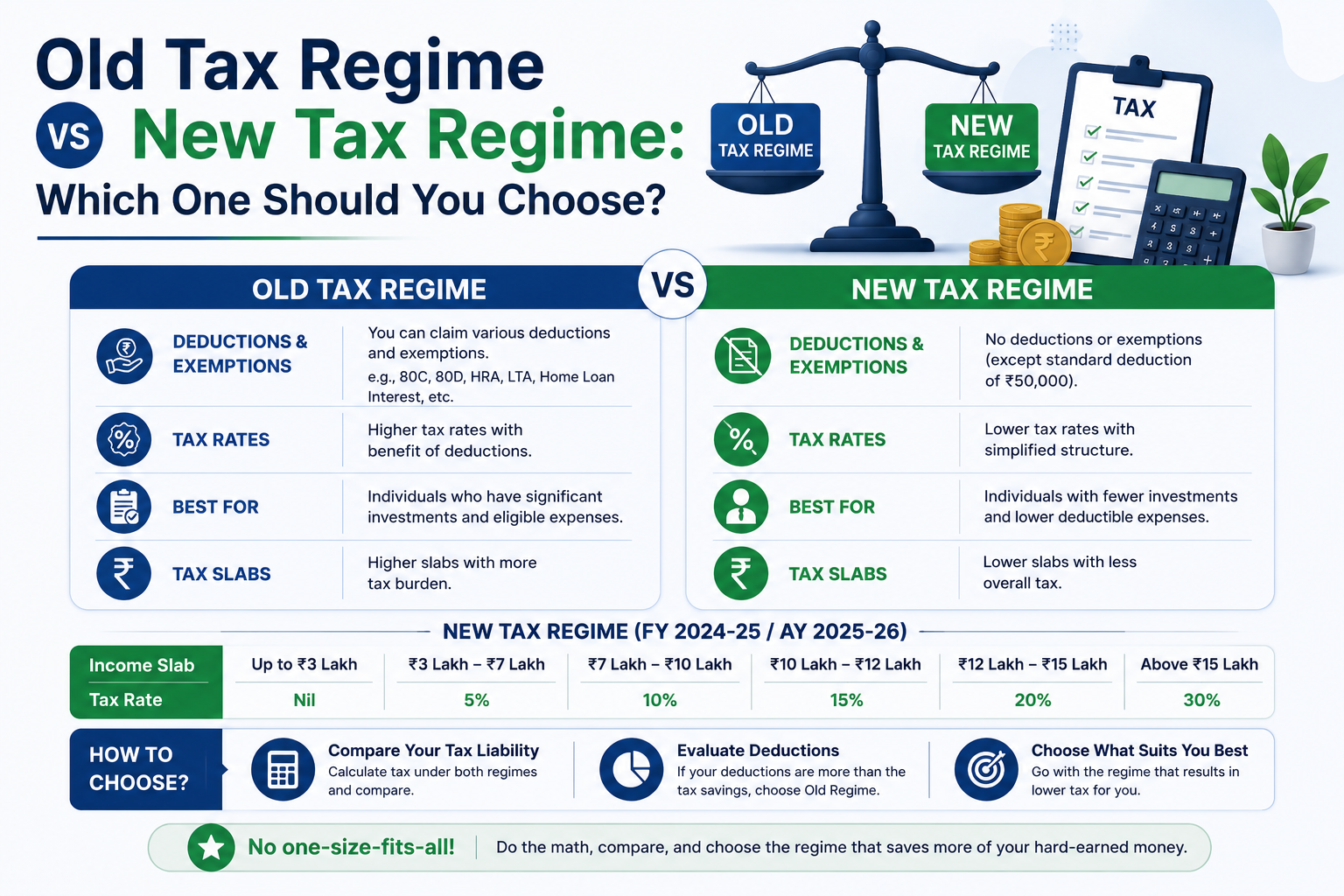
Deciding between the old tax system and the new tax system becomes tricky when there are deductions and exemptions involved. In case of FY 2025-26 (AY 2026-27), the choice of tax regime would be the new tax system unless the taxpayer opts for the old tax system.
There is only one difference between the two tax systems. The old tax system has greater deductions and exemptions but has high slab rates, whereas the new tax system has revised slabs with fewer deductions. It is not necessary that one tax system is better than the other.
Salary, investment, HRA, home loan interest, and some other eligible deductions could change the entire scenario. Knowledge about the old tax system vs. the new tax system would make it easier to decide on the tax system.
What Is the Old Tax Regime?
In the old system, the taxpayer can avail of a larger scope of deductions and exemptions in arriving at the taxable income amount.
Examples of some deductions/exemptions available are:
- 80C deductions
- Health Insurance Premiums under 80D
- HRA deductions, subject to conditions
- Home loan interest deductions under 24(b)
- Some NPS deductions
- And other deductions/exemptions that apply
For an individual under 60 years, the old tax system has a basic exemption of ₹2.5 lakh. Income exceeding the applicable basic exemptions will be taxed at 5%, 20%, and 30%. For senior citizens, there are other applicable basic exemptions.
This is why the old tax system may be better suited for those who have large eligible deductions.
What Is the New Tax Regime?
The new tax regime is the default tax regime and uses revised tax slabs with fewer deductions and exemptions.
For FY 2025-26, the slabs are:
|
Taxable Income |
Tax Rate |
|
Up to ₹4 lakh |
Nil |
|
₹4–8 lakh |
5% |
|
₹8–12 lakh |
10% |
|
₹12–16 lakh |
15% |
|
₹16–20 lakh |
20% |
|
₹20–24 lakh |
25% |
|
Above ₹24 lakh |
30% |
For AY 2026-27, the Section 87A rebate has been increased to ₹60,000 for eligible resident individuals with total income up to ₹12 lakh.
Eligible salaried taxpayers can also claim a ₹75,000 standard deduction under the new regime.
Old Regime vs New Regime: Key Differences
|
Feature |
Old Regime |
New Regime |
|
Tax slabs |
Higher rates |
Revised lower rates at several levels |
|
Standard deduction |
₹50,000 |
₹75,000 |
|
Section 80C |
Available |
Generally not available |
|
Section 80D |
Available |
Generally not available |
|
HRA exemption |
Available, subject to conditions |
Generally unavailable |
|
Home-loan benefits |
Certain benefits available |
More restricted |
|
Section 87A rebate |
Up to ₹12,500 |
Up to ₹60,000 |
|
Deductions |
More |
Fewer |
|
Default regime |
No |
Yes |
Some deductions continue under the new regime, including certain eligible employer contributions to NPS under Section 80CCD(2). Therefore, it is not correct to say that all deductions are unavailable under the new tax regime.
Deductions Under Old vs New Tax Regime
However, the most prominent difference between the old system and the new system is with respect to the deductions.
In the old tax system, eligible individuals can make claims in the form of different deductions like 80C, 80D, HRA and others.
However, the new tax system doesn't allow any deductions and exemptions except for a few specific deductions. This implies that if an individual has a considerable investment or HRA or home loan deduction, then he should do a comparison.
Which Is Better: Old Tax Regime or New Tax Regime?
It’s difficult to give one single answer.
New Tax Regime can be suitable for you if:
- You have fewer deductions.
- You don’t opt for HRA.
- You have fewer tax benefits from home loans.
- You want easy tax computations.
- Revised slabs make your income payable for less tax.
The old tax regime can be suitable for you if:
- You make significant deductions under Section 80C.
- You take the HRA exemption.
- You are eligible for a home loan.
- You pay a premium for health insurance.
Old vs New Tax Regime for Salaried Employees
For salaried individuals, salary should not be considered as the sole factor for making this decision.
For instance, two individuals on equal salaries will have different tax burdens. The former may pay rent, avail of HRA, home loan interest, as well as eligible investments. On the other hand, the latter has very little by way of exemptions.
The former will gain from the old scheme, whereas the latter will gain from the new one.
Hence, you need to compare both schemes by keeping in mind your standard deduction, HRA, home loan interest, 80C investments, 80D, NPS, etc.
How to Choose Between the Old and New Tax Regimes
These are some basic steps that should be followed:
- Total income calculation.
- Listing of deductions and exemptions to which you are entitled.
- Calculation of taxable income according to the old system.
- Calculation of taxable income according to the new system.
- Applying rebate, surcharge and cess.
- Comparing the two.
- Select the one that suits you better.
Do not make any unnecessary investments just to get a tax deduction. See if you can benefit from them as well.
Can You Switch Between Old and New Tax Regimes?
For taxpayers who don’t have any business/professional income, the election may be switched every year by way of the ITR, depending on filing obligations.
Taxpayers who have business/professional income will have different rules regarding their option to opt out of the new regime and must look into their obligations prior to electing.
Common Mistakes When Choosing a Tax Regime
- That the new regime is always superior
- The old regime is always superior since it provides more deductions
- Not considering HRA or home loan deductions
- Neglecting the standard deduction
- Not checking whether 87A is applicable
- Comparing tax slabs without taking into account the total tax payable
- Not considering updated tax slabs
- Wasteful investments just for tax savings
Conclusion
The choice between the new and old taxation regimes needs to be made by evaluating your own income and the available tax deductions instead of just making any generalization.
The new regime provides revised tax slabs along with an increased deduction under Section 87A and an easier process of tax calculation.
The old tax regime is equally beneficial if you enjoy some deductions like 80C, 80D, HRA or any other home loan. During the financial year 2025-26, you need to compare both options before making any decision.
If you have some business income, complicated investments and deductions, it would be better if you take help from a good tax expert.
Frequently Asked Questions
1. Which is better, the old tax regime or new tax regime?
It depends on your income and eligible deductions. Compare the final tax payable under both regimes.
2. What is the main difference between the old and new tax regime?
The old regime offers more deductions and exemptions, while the new regime has revised tax slabs and fewer deductions.
3. Is the new tax regime better for salaried employees?
It can be beneficial for employees with fewer deductions. Those with substantial eligible deductions may prefer the old regime.
4. Can I claim 80C under the new tax regime?
Section 80C is generally not available under the new regime.
5. Can I switch between the two tax regimes?
Eligible non-business taxpayers can generally choose their preferred regime each year, subject to the applicable rules.
6. How do I know which regime will save me more tax?
Calculate your final tax liability under both regimes after considering eligible deductions, rebates, surcharge and cess.