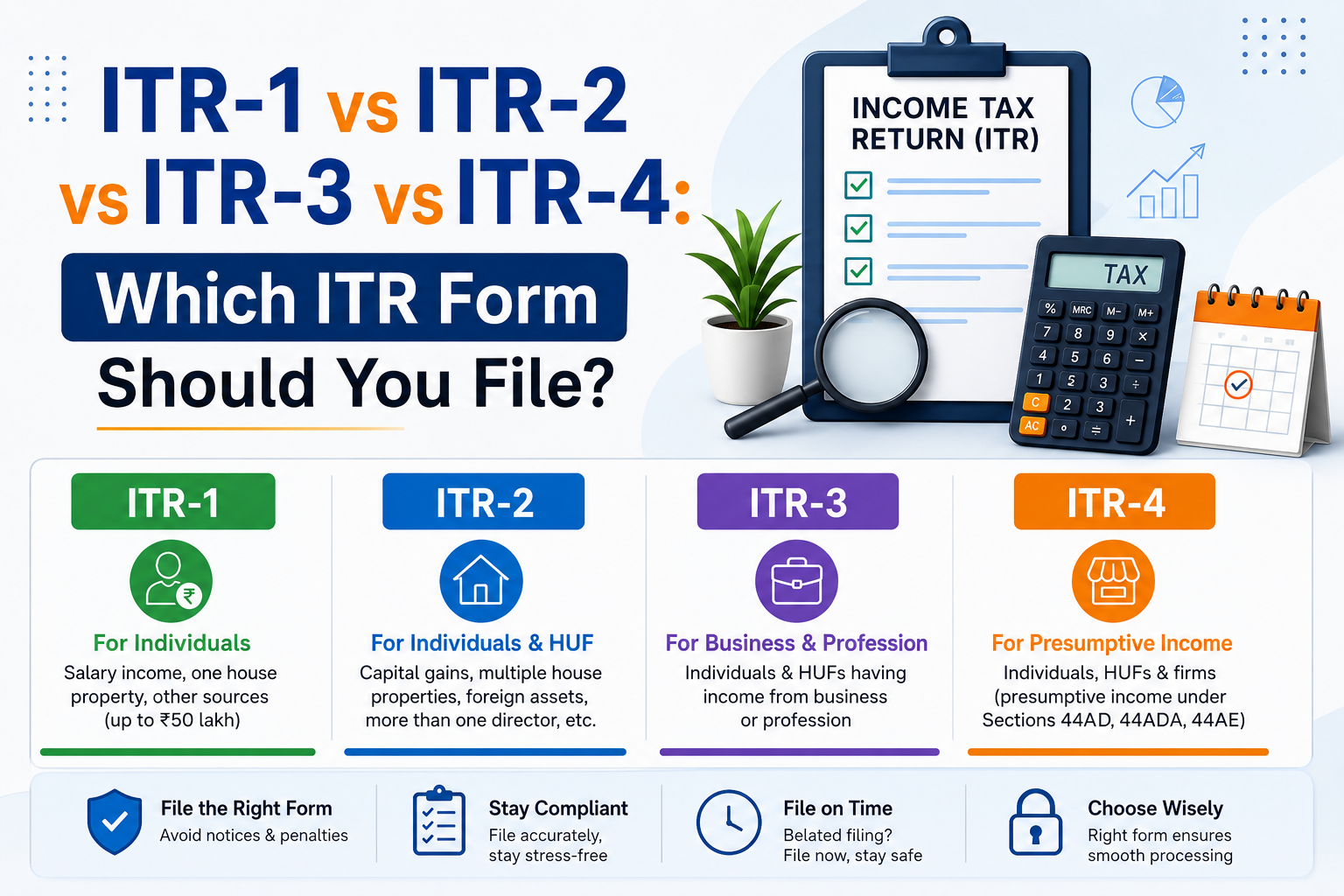
Selecting the appropriate ITR form may become difficult due to income from multiple sources. The choice of the ITR form for AY 2026-27 will depend on various things like income, residential status, capital gains, house property, holding foreign assets, and business income/profession.
The ITR forms that most likely fit an individual or HUF are ITR-1, ITR-2, ITR-3 and ITR-4. Every ITR form has its own conditions and thus just choosing a form because it seems easy may create trouble for you.
Here, we present the main differences between ITR-1, ITR-2, ITR-3 and ITR-4 in order to select an ITR form that is applicable for AY 2026-27.
ITR-1 vs ITR-2 vs ITR-3 vs ITR-4 at a Glance
|
Form |
Mainly for |
Key income |
|
ITR-1 (Sahaj) |
Eligible resident individuals |
Salary, pension, up to 2 house properties, other sources and limited Section 112A LTCG |
|
ITR-2 |
Individuals/HUFs without business income |
Capital gains, foreign income/assets, multiple properties and other complex income |
|
ITR-3 |
Individuals/HUFs with business or professional income |
Business, profession, salary, property, capital gains and other income |
|
ITR-4 (Sugam) |
Eligible presumptive taxpayers |
Presumptive business/professional income under Sections 44AD, 44ADA or 44AE |
The exact form depends on your complete financial situation and the applicable conditions.
What Is ITR-1 (Sahaj)?
ITR-1 form is prepared for resident individual assesses having simple income.
For the financial year 2026-27, it may generally be filled by a resident individual having total income not more than ₹50 lakhs, having income in the form of salary or pension, income from up to two house properties, specified other sources, agricultural income not more than ₹5,000 and LTCG income under section 112A not more than ₹1.25 lakh.
However, the form ITR-1 shall not be applicable in case you have income from business or profession, STCG, LTCG income under section 112A above ₹1.25 lakh, some foreign assets or income, unlisted equity shares, director in any firm/company and some carry forward losses.
What Is ITR-2?
ITR-2 is usually targeted towards individuals and HUFs that have no income from business or profession, but whose incomes or other factors make them ineligible for filing returns using ITR-1.
Such scenarios include, for instance, when there is:
- Capital gains that cannot be shown in ITR-1
- Foreign assets or foreign income
- More than two house properties as a source of income
- Short-term capital gains
- Unlisted equity shares
- Company directorship
- Income in excess of ₹50 lakh
The key difference is that ITR-2 is filed by taxpayers who do not have any business or professional income.
What Is ITR-3?
Form ITR-3 is mainly for individuals and HUFs having profits or gains from business or profession.
The above includes proprietorships, doctors, lawyers, consultants, freelancers and others who earn business or professional income.
In addition to profits from business or profession, Form ITR-3 may include salary or pension, income from house property, capital gains and income from other sources.
If the income earned by you from business or profession is not calculated under presumptive taxation rules and is thus making you eligible to file ITR-4, you should use ITR-3.
What Is ITR-4 (Sugam)?
The form ITI-4 is designed for those taxpayers who have business or professional income under presumptive taxation.
In case of AY 2026-27, eligible individual residents, HUFs and other companies except LLPs, having total income up to ₹50 lakh, may file ITR-4 when business or professional income is calculated under Sections 44AD, 44ADA or 44AE, with all the prescribed qualifications.
This form may also be used for salary/pension of a certain kind, two or fewer house properties, other sources of income and certain section 112A long-term capital gains not exceeding ₹1.25 lakh.
There are certain situations where Form ITR-4 cannot be used.
ITR-1 vs ITR-2 vs ITR-3 vs ITR-4: Key Differences
|
Factor |
ITR-1 |
ITR-2 |
ITR-3 |
ITR-4 |
|
Salary/pension |
Yes |
Yes |
Yes |
Yes |
|
House property |
Up to 2 |
Yes |
Yes |
Up to 2 |
|
Capital gains |
Limited |
Yes |
Yes |
Limited |
|
Business income |
No |
No |
Yes |
Yes, presumptive |
|
Professional income |
No |
No |
Yes |
Yes, presumptive |
|
Foreign assets/income |
No |
Yes |
Yes |
No |
|
Income limit |
₹50 lakh |
No ₹50 lakh limit |
No general ₹50 lakh limit |
₹50 lakh |
|
Presumptive taxation |
No |
No |
Where applicable |
Yes |
Which ITR Form Should You File? Simple Examples
Salaried Employee: For salary, interest income from banks and eligible income from house property, the ITR-1 form may be applicable if all conditions are satisfied.
Salaried individual having capital gains: For individuals who have short-term capital gains or capital gains that cannot be entered through the ITR-1, the ITR-2 form may be applicable.
Professional /Freelancer: A doctor, lawyer, consultant, or freelancer having professional income may opt for ITR-4 form in case he is eligible for presumptive taxation; otherwise, ITR-3 may be applicable.
Business Person (proprietorship): For individuals who are eligible and opt for presumptive taxation, ITR-4 may be applicable. Else, the ITR-3 form may be applicable.
Foreign Assets/Income: In cases where the foreign asset/income exclusion applies to specified individuals, forms ITR-1 & ITR-4 cannot be used.
How to Choose the Correct ITR Form for AY 2026-27
Prior to filing the return, answer the following questions:
- Do I earn professional/business income?
- In case of yes, do I qualify for presumptive taxation?
- Do I have capital gains?
- Do I have foreign property or foreign income?
- Do I have more than two houses?
- Does my total income exceed ₹50 lakh?
- Do I have any losses that are required to be carried forward?
- Are there any other conditions that exclude the use of ITR-1/ITR-4 forms?
The Income Tax Department also offers an online utility for calculating the right ITR form according to the taxpayer’s situation.
Common Mistakes to Avoid
- Choosing ITR-1 just because you are salaried
- Ignoring capital gains from shares, mutual funds, or property
- Forgetting to check residential status
- Overlooking foreign assets and income
- Confusing regular business income with presumptive taxation
- Choosing ITR-4 without checking its eligibility conditions
- Ignoring losses that need to be carried forward
- Using last year's form without checking AY 2026-27 rules
Conclusion
Selection of the appropriate ITR form is a crucial aspect of filing an accurate income tax return. In AY 2026-27, the ITR-1 form can be used by eligible individuals having simple income, while the ITR-2 form can be used by individuals and HUFs having complex finances without any business income.
Form ITR-3 is mostly used for business or professional income, while ITR-4 is an easy form to file for eligible taxpayers under presumptive taxation. One must first check their sources of income, capital gains, house property, residence status, and foreign assets before filing their returns.
If the finances have complex business income, foreign income, capital gains, or other complicated tax affairs, then it is recommended to consult a professional tax consultant.
Frequently Asked Questions
1. Which is better, the old tax regime or new tax regime?
It depends on your income, deductions and exemptions. Compare the final tax payable under both regimes before choosing.
2. What is the main difference between the old and new tax regime?
The old regime offers more deductions and exemptions, while the new regime has revised tax slabs with fewer deductions.
3. Is the new tax regime better for salaried employees?
It may be beneficial for employees with fewer deductions. Those with substantial HRA, home-loan or other eligible deductions may benefit from the old regime.
4. Can I claim 80C under the new tax regime?
Generally, Section 80C deductions are not available under the new tax regime.
5. Can I switch between the old and new tax regimes?
Eligible taxpayers without business or professional income can generally choose their preferred regime each year, subject to applicable rules.