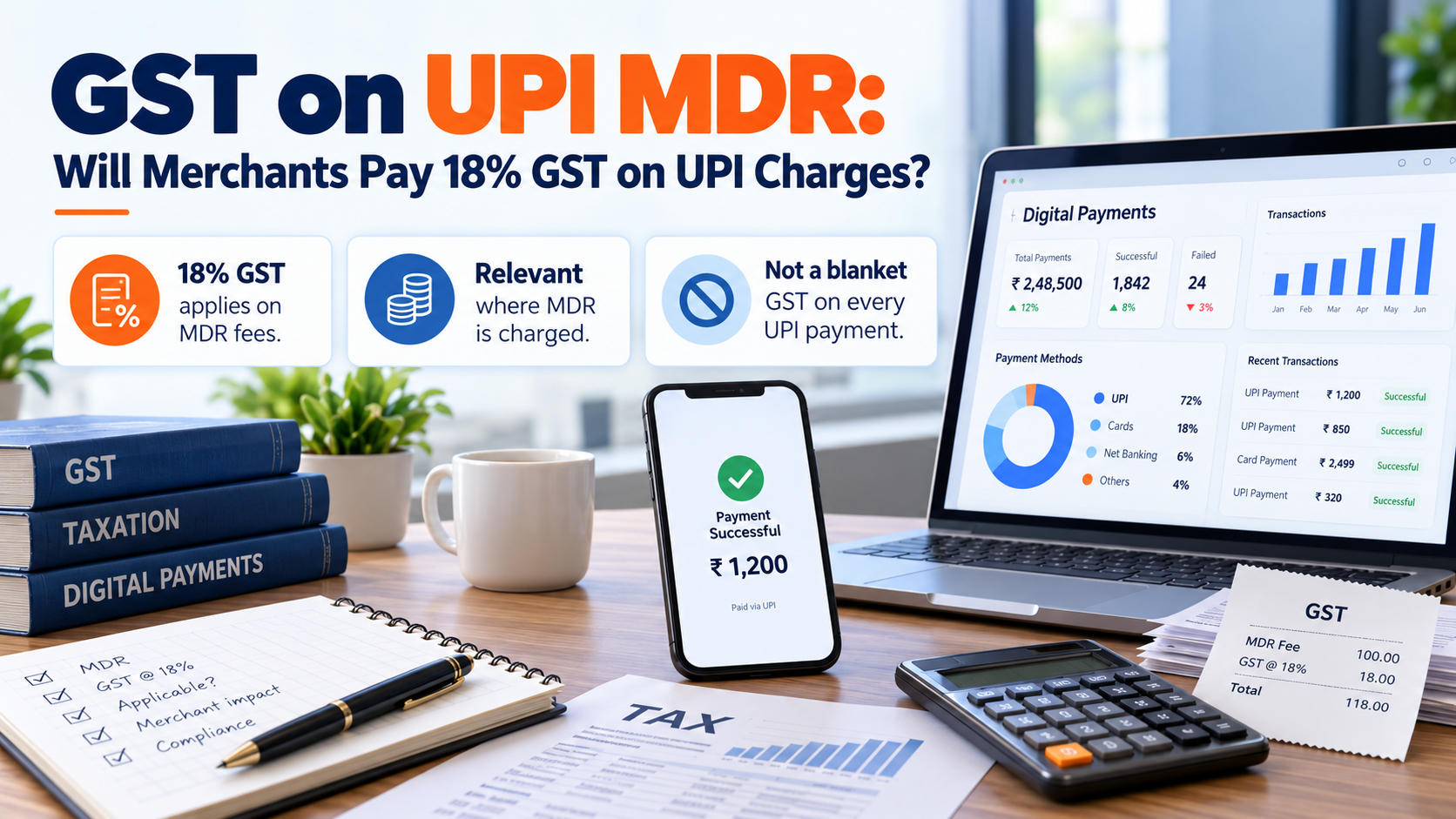
A recent change in the UPI payment framework has raised an important question for businesses: Will merchants now have to pay 18% GST on UPI charges? The answer depends on whether an MDR or another taxable service fee is actually charged.
UPI itself is not a GSTable transaction, and customers continue to make UPI payments without transaction charges. However, certain higher-value merchant transactions can now attract MDR.
In this blog, we will cover GST on UPI MDR, when MDR applies, whether 18% GST is charged, and what merchants need to check.
What Is UPI MDR?
MDR, or Merchant Discount Rate, is a fee associated with processing a merchant payment. It is not a tax collected by the Government.
Under the updated UPI framework announced in September 2026, MDR applies only to specified merchant transactions. The Government has clarified that MDR is distributed among participants in the payment ecosystem, such as banks and payment service providers.
This is different from GST. MDR is a payment-processing charge, while GST is a tax that may apply to a taxable service or supply.
Is MDR Now Applicable on UPI Payments?
Yes, but not on all UPI transactions.
Under the current framework:
- Person-to-person (P2P) UPI transactions remain free.
- Merchant payments up to ₹2,000 remain free of MDR.
- Small merchants covered by the zero-MDR framework continue to receive this benefit.
- A nominal 0.4% MDR applies to specified person-to-merchant (P2M) transactions above ₹2,000.
- For transactions of ₹75,000 and above, the MDR is capped at ₹300 per transaction.
- Certain essential sectors have separate flat-rate provisions.
The Government estimates that approximately 96% of merchant UPI transactions remain unaffected by the MDR framework.
Will Merchants Pay 18% GST on UPI Charges?
The important distinction is between GST on a UPI payment and GST on an MDR/service charge.
A merchant does not pay 18% GST simply because a customer makes a UPI payment. The payment itself is not a separate taxable service supplied to the merchant.
However, where a payment service provider or other service provider charges a merchant a taxable service fee, GST can apply to that service charge at the applicable rate. CBIC's GST rate schedule provides an 18% rate for specified financial and related services under Heading 9971.
Therefore, saying “18% GST will be charged on every UPI payment” is incorrect.
The correct way to understand it is:
UPI payment → not automatically subject to 18% GST
Taxable MDR/service fee → GST may apply to the fee at the applicable rate
Example: How Would GST on MDR Work?
Suppose a merchant makes a qualifying UPI transaction of ₹10,000 and an MDR of 0.4% is applicable.
MDR = ₹10,000 × 0.4% = ₹40
If the applicable GST on that taxable service fee is 18%:
GST on MDR = ₹40 × 18% = ₹7.20
So the merchant's payment-related charge would be ₹47.20, consisting of ₹40 MDR and ₹7.20 GST, assuming the stated GST treatment applies.
The important point is that the 18% GST is calculated on the MDR/service fee, not on the ₹10,000 UPI transaction value.
Does GST Apply to the Merchant's Sale?
This is a separate issue.
If a merchant sells taxable goods or services, GST may apply to the underlying supply according to the applicable GST rules. It does not matter whether the customer pays through UPI, cash, card or another payment method.
For example, if a customer purchases taxable goods worth ₹10,000 and pays through UPI, the GST on the sale is determined by the GST rate applicable to those goods. The payment method does not create an additional 18% GST on the ₹10,000.
UPI Payment vs MDR vs GST
|
Particular |
Meaning |
GST Treatment |
|
UPI payment |
Payment made by customer to merchant |
No GST merely because UPI is used |
|
MDR |
Payment-processing charge applicable in specified cases |
GST may apply to the taxable service fee |
|
GST on sale |
Tax on taxable goods/services sold by merchant |
Depends on the applicable GST rate |
|
P2P UPI payment |
Payment between individuals |
Remains free |
The Government has specifically clarified that MDR is not a tax and that customers will not be charged MDR for making UPI payments.
What Should Merchants Check?
Businesses accepting UPI should review their settlement statements and payment-provider invoices carefully.
Check:
- Whether MDR has actually been charged
- The applicable MDR rate
- Whether GST is separately shown on the MDR/service fee
- Whether the transaction falls under a zero-MDR category
- Whether the payment provider has charged any other service fee
- Whether settlement amounts match the business records
Do not assume that every deduction from a UPI settlement is MDR. It is better to check the description and supporting invoice or statement provided by the payment service provider.
Common Misconceptions About GST on UPI
“18% GST is charged on every UPI payment.”
Incorrect. GST is not automatically charged on the UPI transaction amount.
“UPI above ₹2,000 automatically attracts 18% GST.”
Incorrect. The current framework provides for MDR on specified merchant transactions above ₹2,000. GST, where applicable, relates to the taxable service fee—not automatically to the entire UPI payment.
“MDR and GST are the same thing.”
No. MDR is a payment-processing charge, whereas GST is a tax that may apply to a taxable service.
“Merchants must add 18% GST to every UPI payment.”
No. The merchant's GST liability on a sale depends on the underlying goods or services and applicable GST rules, not on whether the customer used UPI.
Conclusion
The introduction of MDR for certain higher-value UPI merchant transactions does not mean that merchants will pay 18% GST on every UPI payment. UPI itself is not the taxable event.
Where a qualifying MDR or other taxable payment-processing service fee is charged, GST may apply to that fee at the applicable rate. Meanwhile, P2P transactions and most merchant UPI payments remain free under the current framework.
For businesses, checking settlement statements, MDR and GST separately is important. FinSpyne can help you understand GST implications, reconcile payment charges and manage your business tax compliance with greater clarity.
Frequently Asked Questions About GST on UPI MDR
Is there 18% GST on UPI payments?
No. UPI payments are not automatically subject to 18% GST. GST may apply to a taxable Merchant Discount Rate (MDR) or other applicable service fee, rather than to the underlying UPI transaction value. Therefore, an 18% GST charge on MDR should not be confused with an 18% GST charge on the UPI payment itself.
Is UPI MDR currently zero?
The position is changing under the new UPI framework. From 15 October 2026, specified person-to-merchant (P2M) UPI transactions above ₹2,000 can attract MDR. P2M transactions of ₹2,000 or below and specified transactions received by small merchants under the zero-MDR framework will remain free of MDR. Person-to-person (P2P) UPI transactions will also remain free.
Who pays UPI MDR?
MDR is a charge within the merchant payment ecosystem. It is not intended to be a charge on customers making UPI payments. The government has stated that banks should ensure merchants do not pass MDR charges on to customers.
Is GST charged on the full UPI transaction amount?
No. Where the applicable MDR or service fee is a taxable supply, GST is calculated on the taxable fee or charge, not on the full underlying UPI transaction value.
For example, if an applicable MDR is ₹40 on a transaction, GST would be calculated on the applicable ₹40 fee, rather than on the entire transaction amount.
Does UPI payment change the GST on a sale?
No. GST on the underlying sale depends on the nature, classification and taxability of the goods or services supplied. The payment method, such as UPI, does not by itself change the GST applicable to the underlying sale.
Will small merchants have to pay UPI MDR on transactions above ₹2,000?
Not necessarily. The new framework provides zero-MDR treatment for specified small merchants, including eligible small merchants receiving up to ₹1 lakh per month through UPI QR codes under the P2PM category. Therefore, eligibility should be checked based on the applicable merchant category and conditions rather than only the transaction amount.
What is the MDR rate for UPI transactions above ₹2,000?
Under the new framework, a 0.4% MDR applies to specified P2M UPI transactions above ₹2,000, subject to applicable categories and caps. For transactions of ₹75,000 or more, the MDR is capped at ₹300 per transaction. Certain essential sectors have a flat MDR structure instead.