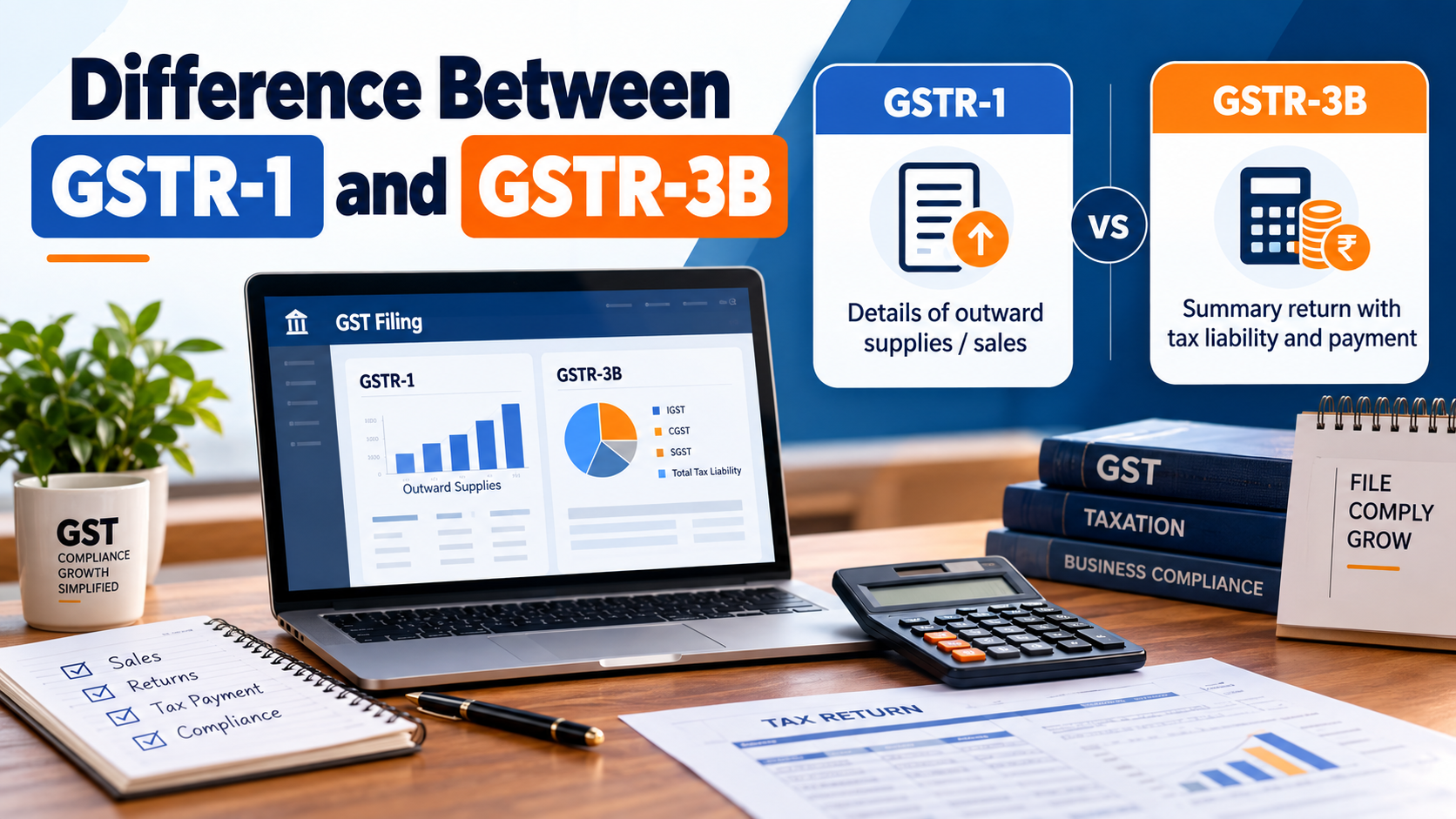
Filing GST returns can become confusing when you need to submit both GSTR-1 and GSTR-3B for the same tax period. Although both returns contain information related to your GST transactions, they serve different purposes.
GSTR-1 mainly reports details of outward supplies, while GSTR-3B is a summary return used to declare GST liabilities and discharge the tax payable. Understanding this difference can help businesses avoid errors and mismatches.
In this blog, we will cover the difference between GSTR-1 and GSTR-3B, what information each return contains, their due dates, and how businesses can avoid common filing mistakes.
What Is GSTR-1?
GSTR-1 is a monthly or quarterly statement of outward supplies filed by regular and casual taxpayers making supplies of goods or services. It contains details of sales and other outward-supply transactions for the relevant tax period.
Depending on the applicable requirements, GSTR-1 can include:
- Invoice-level details of supplies to registered persons
- Specified inter-State supplies to unregistered persons
- Export details
- Credit and debit notes
- Advances received and their adjustments
- Amendments to previously reported details
- Nil-rated, exempt and non-GST supplies
- HSN/SAC-wise summary of outward supplies
In simple terms, GSTR-1 tells the GST system what you have sold or supplied during a tax period.
What Is GSTR-3B?
GSTR-3B is a simplified summary GST return through which taxpayers declare their GST liabilities and discharge the tax payable for a particular tax period.
It generally includes:
- Taxable outward supplies
- Supplies liable to reverse charge
- Eligible Input Tax Credit (ITC)
- ITC reversals and other applicable adjustments
- Exempt, nil-rated and non-GST inward supplies
- Interest and late fee, where applicable
- Payment and offset of tax liability
Unlike GSTR-1, GSTR-3B does not function as an invoice-by-invoice statement. It is primarily a summary declaration of tax liability and ITC.
Difference Between GSTR-1 and GSTR-3B
|
Particular |
GSTR-1 |
GSTR-3B |
|
Primary purpose |
Reports outward supplies |
Summarizes tax liability and ITC |
|
Nature |
Statement of outward supplies |
Summary GST return |
|
Main information |
Invoice/supply details, amendments, credit/debit notes, exports, etc. |
Taxable supplies, tax liability, eligible ITC and payment |
|
GST payment |
Not the primary payment return |
Used to discharge GST liability |
|
Nil filing |
Required where applicable |
Nil GSTR-3B can be filed when the prescribed nil-return conditions are met |
|
Can it be revised? |
Filed data has specific amendment mechanisms |
GSTR-3B itself cannot be revised after filing |
The GST Portal describes GSTR-1 as the statement of outward supplies and GSTR-3B as the simplified summary return for declaring and discharging GST liabilities.
What Is the Difference Between GSTR-1 and GSTR-3B Due Dates?
The due date depends on whether the taxpayer files returns monthly or under the quarterly scheme.
GSTR-1 is usually due from monthly filers on the 11th of the subsequent month, while GSTR-3B is due from them on the 20th of the subsequent month.
As part of the QRMP, certain Quarterly filers have the due dates for GSTR-1 and GSTR-3B relaxed. Quarterly filers have to file GSTR-1 by the 13th of the month following the end of the quarter and GSTR-3B by the 22nd or 24th, based on the State/UT.
These due dates may be altered by a government notification. Hence, taxpayers should verify the GST portal to determine the due dates for return filings.
Why Should GSTR-1 and GSTR-3B Be Reconciled?
Businesses must compare their books of accounts, GSTR-1 and GSTR-3B periodically.
For instance, if a GSTR-1 report shows a sale that is different from the outward supply as shown in GSTR-3B, then this discrepancy must be investigated.
There can be several reasons for this difference, including adjustments, credit notes, differences in the timing of the documents, etc.
Due to automatic population of certain details from GSTR-1/1A, the GST portal states that there may be differences in the figures shown in GSTR-3B and GSTR-1/1A.
Reconciliations should be done regularly to identify differences and errors.
What If There Is a Difference Between GSTR-1 and GSTR-3B?
If the figures do not match, do not simply change numbers to make them identical. First, identify why the difference occurred.
A practical approach is:
- Compare the sales ledger with GSTR-1.
- Compare the outward-supply and tax-liability figures with GSTR-3B.
- Check credit notes, debit notes and amendments.
- Review the relevant tax period for timing differences.
- Correct eligible errors through the applicable GST mechanism.
- Keep supporting documents for the reconciliation.
For certain corrections to GSTR-1, GSTR-1A may also be available before filing GSTR-3B for the same tax period. The GST Portal describes GSTR-1A as an optional facility for amending or adding records for the same period before GSTR-3B is filed.
Common Mistakes to Avoid
Businesses should be careful about:
- Entering incorrect invoice values in GSTR-1
- Missing credit or debit notes
- Reporting incorrect taxable values in GSTR-3B
- Claiming incorrect or ineligible ITC
- Failing to reconcile sales with books
- Assuming GSTR-1 and GSTR-3B are interchangeable
- Filing without reviewing auto-populated information
- Ignoring discrepancies between returns
GSTR-3B should be reviewed carefully because the GST Portal does not allow amendment of an already filed GSTR-3B.
Conclusion
There are some similarities between GSTR-1 and GSTR-3B; however, they are primarily different. As mentioned earlier, GSTR-1 reports outward supplies, while GSTR-3B reports tax liability, input tax credit, and tax payment.
To report correct GST liability, it is essential to keep accurate books, invoices and GST returns. An organization’s GST liability may increase due to the volume of transactions. Hence, it becomes essential to take the support of a professional.
FinSpyne offers end-to-end practical support for organizations to be GST and tax compliant.
Frequently Asked Questions About GSTR-1 and GSTR-3B
Is GSTR-1 the same as GSTR-3B?
No. GSTR-1 and GSTR-3B are different GST filings. GSTR-1 is a statement of outward supplies containing details of goods and services supplied during the tax period. GSTR-3B is a summary return used to declare tax liabilities and eligible input tax credit and to discharge the resulting tax liability.
Which return is used for payment of GST?
GSTR-3B is used to declare the tax liability and discharge the GST payable for the relevant tax period. GSTR-1 primarily reports details of outward supplies and related information.
Are differences between GSTR-1 and GSTR-3B allowed?
Differences can occur because of legitimate factors such as amendments, timing differences, credit or debit notes, and other reporting adjustments. However, taxpayers should regularly reconcile GSTR-1 and GSTR-3B and investigate material or unexplained differences to ensure that the correct tax liability has been reported and paid.
Is GSTR-1 required if there are no taxable supplies?
Yes. For taxpayers who are required to file GSTR-1, the GST Portal states that GSTR-1 must be filed even when there is no business activity during the tax period, by filing a Nil return. Certain categories of taxpayers are excluded from the GSTR-1 filing requirement under the GST rules.
Can GSTR-3B be revised once it is filed?
No. GSTR-3B cannot be revised once filed. If an error is identified after filing, the appropriate adjustment may generally need to be made in a subsequent applicable return, depending on the nature of the error and the GST rules.
What is the main difference between GSTR-1 and GSTR-3B?
The main difference is their purpose. GSTR-1 reports outward supply details, including invoice and related supply information, while GSTR-3B summarizes GST liability and input tax credit and is used to discharge the tax payable.
Why should GSTR-1 and GSTR-3B be reconciled?
GSTR-1 and GSTR-3B should be reconciled to identify differences in outward supplies, tax liability, amendments, credit or debit notes, and other reporting items. Regular reconciliation can help taxpayers identify errors and address potential mismatches before they result in compliance issues